Carpet Beetle vs Carpet Moth: Quick Comparison
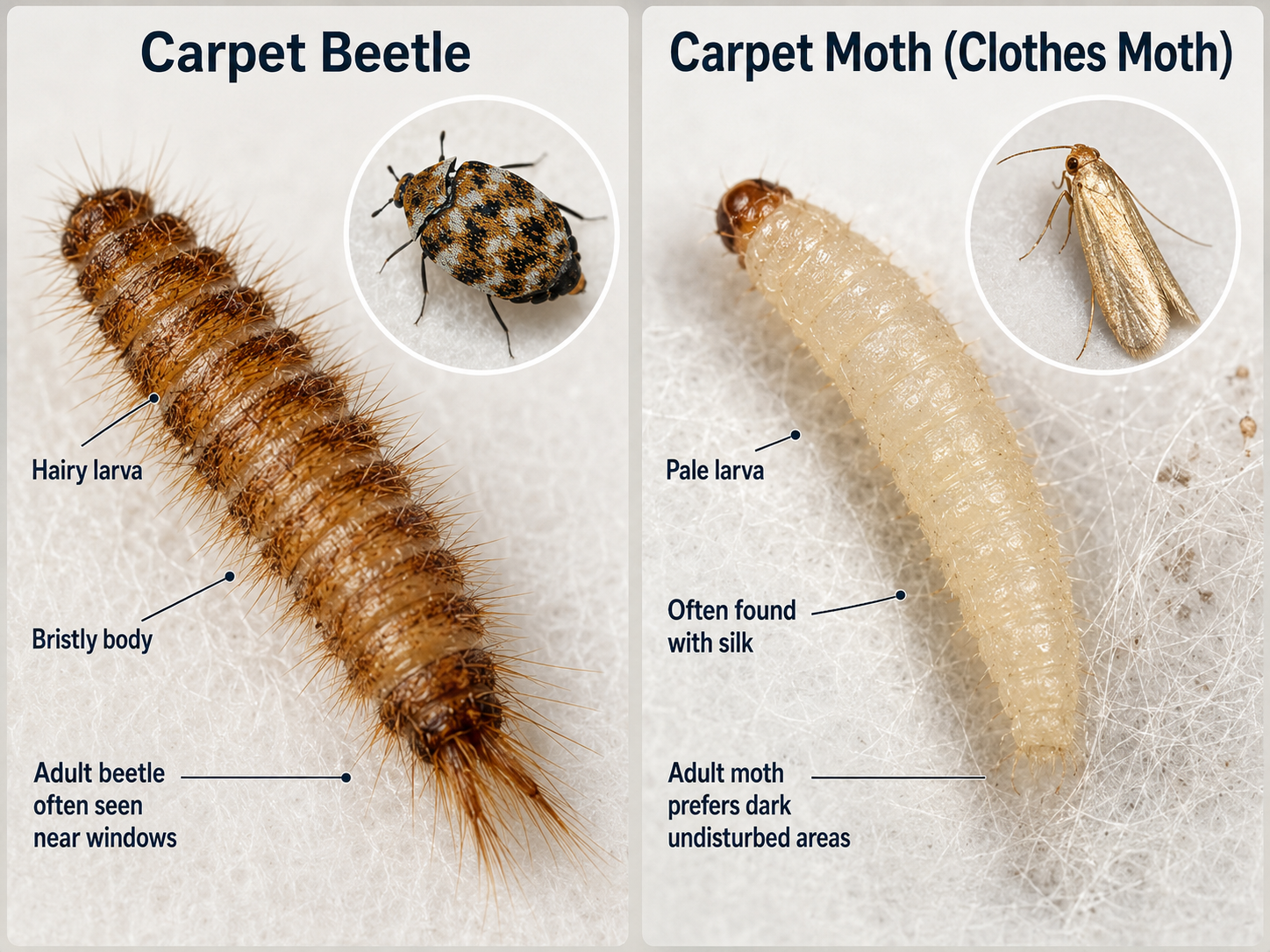
Carpet beetle adults are tiny rounded or oval beetles.
Carpet moth adults are small buff, golden or brownish moths.
Carpet beetle larvae are usually brown, hairy, fuzzy or bristly.
Carpet moth larvae are usually creamy white or pale caterpillars with a darker head.
Hairy shed skins are one of the strongest signs of carpet beetles.
Silk webbing, feeding tubes or portable silk cases are stronger signs of clothes moths.
Adult carpet beetles are often found around windows.
Adult clothes moths usually prefer dark and undisturbed areas.
Both pests cause their main damage during the larval stage.
Both can damage wool carpet, rugs, clothing and other suitable natural materials.
The Fastest Way to Identify Which Pest You Have
Do not begin with the size or shape of the holes.
Start with the material around the damaged area.
If you find a brown hairy larva or hairy cast skin, carpet beetle becomes much more likely.
If you find a creamy larva with fine silk, clothes moth becomes much more likely.
If you find a small rice-like silk case attached to or moving across fabric, case-bearing clothes moth becomes much more likely.
If tiny beetles repeatedly appear around windows, investigate carpet beetles.
If small buff moths stay around dark wardrobes, rugs or carpet edges, investigate clothes moths.
If you only have holes or thinning fabric with no insects or residue, identification remains uncertain.
Damage alone can mislead you because both insects can feed on similar materials.
What Does a Carpet Beetle Look Like?
Adult carpet beetles are very small beetles.
Depending on the species, adults can look mottled, brown, black, grey, white, tan or patterned.
A common varied carpet beetle has a rounded or oval body covered in mottled scales that can include black, white, tan and orange-brown colouring.
The adult can be so small that people mistake it for a seed, tiny ladybird or random household bug.
A useful behavioural clue is location.
Adult carpet beetles are often noticed near windows because adults can move toward light.
Finding one adult near a window does not prove your carpet is infested.
Repeated adults combined with larvae, shed skins or textile damage are much stronger evidence.
What Do Carpet Beetle Larvae Look Like?
This is usually the easiest stage to recognise.
Carpet beetle larvae are generally brown or tan, segmented, hairy, bristly and somewhat fuzzy in appearance.
They are sometimes called woolly bears.
Many have an elongated or carrot-shaped body with noticeable hairs and longer bristles toward the rear.
One of their most useful identification clues is what they leave behind.
As the larvae grow, they moult.
The old larval skin can remain in carpet edges, wardrobes, along skirting boards, underneath furniture or near damaged textiles.
These shed skins can look like small, dry, brown, hairy husks.
Remember this simple rule.
Hairy larvae plus hairy shed skins strongly suggest carpet beetles.
What Does a Carpet Moth Look Like?
Carpet moth is the phrase many homeowners use when they find moth activity in carpets.
The more accurate pest-control term is usually clothes moth.
Adult clothes moths are small.
They may appear golden, buff, straw coloured, beige or brownish.
Their wings are narrow and usually rest close to the body.
Their behaviour provides another clue.
Many outdoor moths fly noticeably around lights.
Clothes moths often behave differently.
They generally prefer dark, protected and undisturbed locations such as wardrobes, drawers, carpet edges, underneath furniture and areas around stored fabrics.
A small golden moth repeatedly appearing around dark textile storage areas deserves investigation.
What Do Carpet Moth Larvae Look Like?
Clothes moth larvae are pale caterpillar-like insects.
They are generally creamy white or pale with a darker brown head.
They do not have the obvious fuzzy and bristly appearance associated with carpet beetle larvae.
The strongest clue is often silk.
Webbing clothes moth larvae produce silk webbing while feeding.
You may find fine silk over the material together with fibres, feeding debris and frass.
Case-bearing clothes moth larvae build a protective silken case.
The larva lives inside the case and carries it while moving and feeding.
These cases can resemble tiny grains of rice or narrow tubes made from silk and surrounding textile fibres.
Remember this rule.
Pale larva plus silk webbing or a portable silk case strongly suggests clothes moth.
Carpet Beetle Damage vs Carpet Moth Damage
People often try to identify the pest from the hole alone.
That is one of the weakest diagnostic methods.
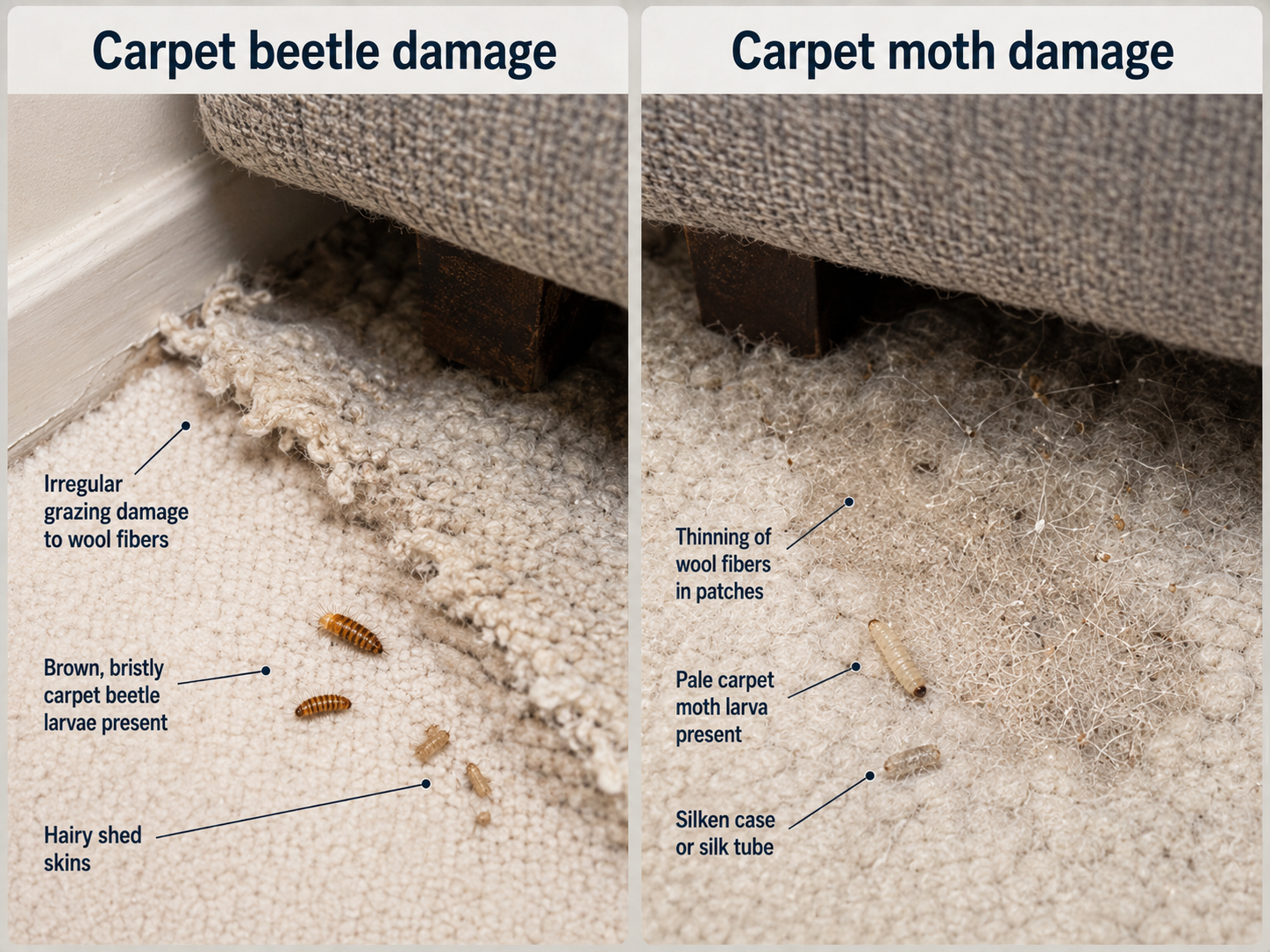
Carpet beetle larvae may create irregular holes, grazed areas, surface damage or broader patches of textile loss.
Clothes moth larvae can also create irregular holes and surface grazing.
Webbing, tubes or cases around the damaged material provide much stronger evidence of moth activity than the shape of the hole itself.
Carpet beetle damage is more convincing when brown bristly larvae or hairy shed skins are nearby.
Carpet moth damage is more convincing when pale larvae, fine silk webbing or small silken cases are nearby.
A better question is not, “What shape is the hole?”
Ask, “What evidence is sitting beside the hole?”
Silk points toward moths.
Hairy cast skins point toward carpet beetles.
That is a more useful distinction.
Carpet Beetle vs Carpet Moth Larvae
If you are looking directly at the insect, the larvae provide one of the clearest differences.
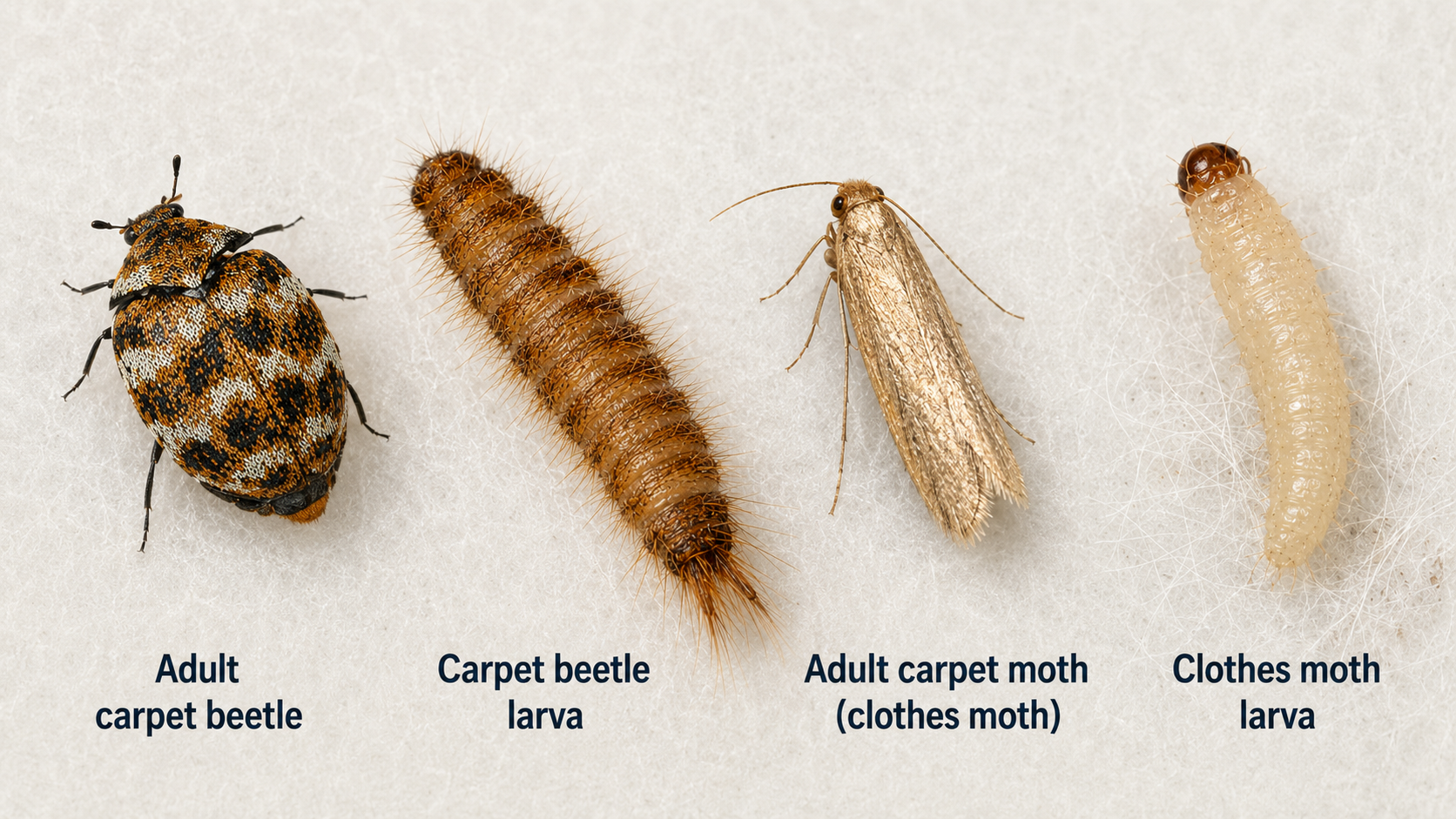
A carpet beetle larva is usually brown or tan.
A carpet moth larva is usually cream or pale.
A carpet beetle larva is noticeably hairy and bristly.
A carpet moth larva is relatively smooth.
A carpet beetle larva often has a short grub-like or carrot-shaped body.
A carpet moth larva has a more caterpillar-like appearance.
Carpet beetle larvae do not produce the feeding webbing associated with clothes moths.
Clothes moth larvae may produce silk webbing.
Carpet beetles do not carry portable silk cases.
Case-bearing clothes moth larvae do.
Hairy shed skins are one of the strongest signs of carpet beetles.
Silk is one of the strongest signs of carpet moths.
If you can photograph the larva clearly beside a ruler or coin, identification becomes easier.
Carpet Beetle Shed Skin vs Carpet Moth Silk
This is one of the best comparisons for homeowners.
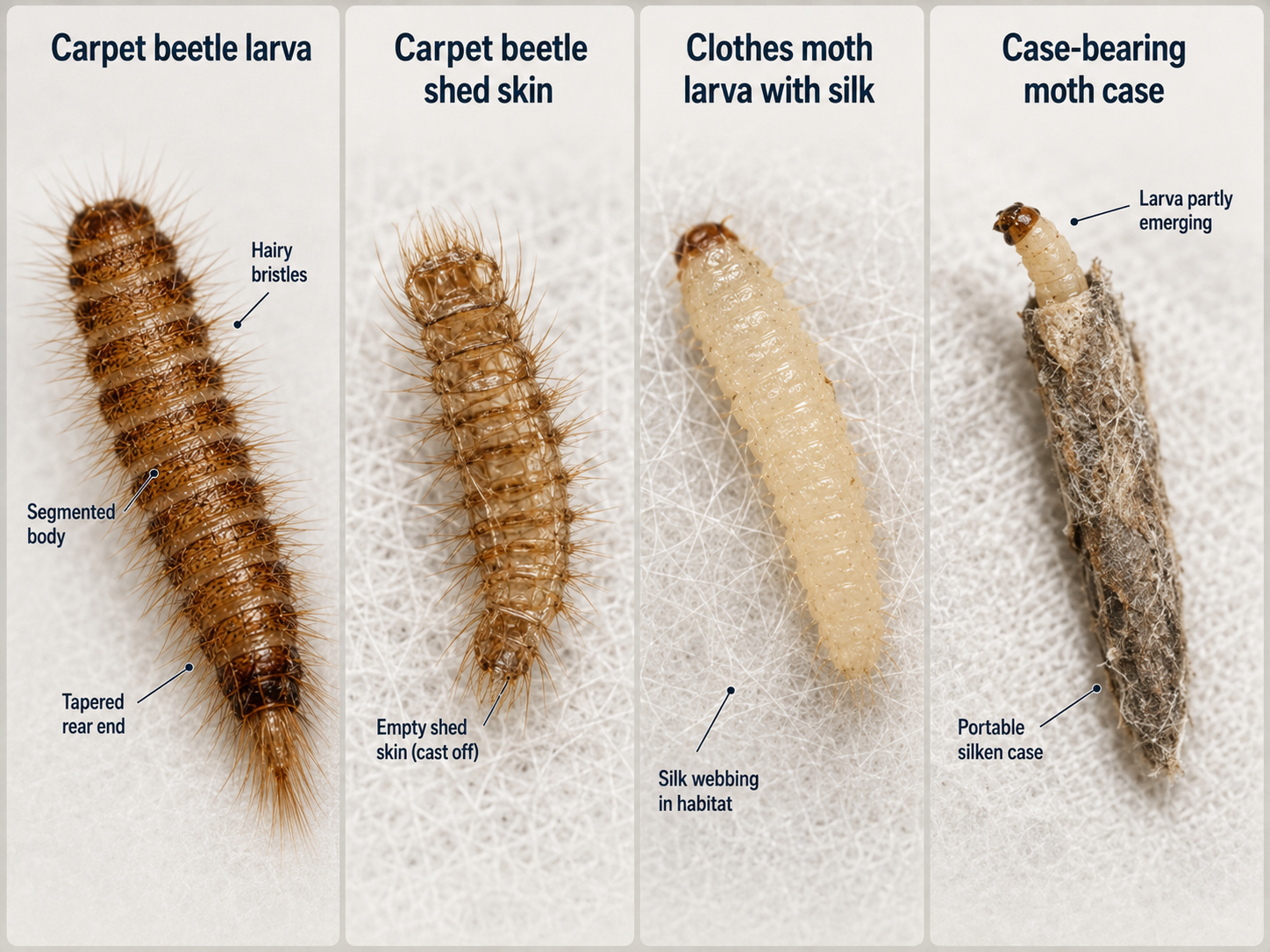
Carpet beetle larvae moult as they develop.
Their old skin remains behind as a dry, brown, hairy shell.
It may look like a dead larva at first glance.
Look closely and it may appear hollow or empty.
Clothes moth larvae leave a different type of evidence.
Webbing clothes moths can produce fine silk over the feeding area.
The silk may become mixed with fibres, frass and debris.
Case-bearing clothes moths create a portable silken case that may contain fibres from the material being eaten.
So if you find a brown, empty, hairy husk, think carpet beetle.
If you find silk webbing or a small textile-covered case, think clothes moth.
Carpet Beetle vs Carpet Moth Eggs
Eggs are far less useful for homeowners trying to identify an infestation.
Both pests have small eggs that can be hidden deep within suitable materials.
Carpet beetle eggs are laid around areas where emerging larvae will have access to food.
That can include carpet, clothing, fur, feathers, lint, animal material and other suitable food sources.
Clothes moth females also place eggs where larvae will have immediate access to suitable textile material.
In practical identification, searching for larvae, cast skins, webbing and cases is usually more productive than hunting for individual eggs.
You do not need to find an egg before taking an infestation seriously.
Where Carpet Beetles Usually Hide
Carpet beetle larvae can move through dark areas looking for food.
Their diet is relatively broad.
Besides wool and other textiles, they may survive around animal hair, feathers, fur, lint, dead insects and other animal-based material.
Common places to inspect include carpet edges, underneath furniture, along skirting boards, wardrobes, rugs, stored textiles, pet resting areas, lint-filled gaps, roof spaces and areas containing old animal or insect material.
Bird nests can also provide suitable material for carpet beetles in some properties.
This wider feeding range is one reason carpet beetle infestations can be difficult to trace back to one item.
Where Carpet Moths Usually Hide
Clothes moths strongly favour dark, undisturbed textile areas.
Inspect beneath sofas, beds and heavy furniture.
Inspect the underside and edges of wool rugs.
Check wardrobes, drawers and stored clothing.
Check carpet along skirting boards.
Check folded wool blankets and garments that have not been moved for long periods.
One common scenario is damage hidden beneath furniture while the exposed carpet still looks normal.
Darkness, limited disturbance and access to suitable textile fibres can allow larvae to remain unnoticed for a long time.
Carpet Beetle vs Carpet Moth on Wool Carpet
Both pests can damage wool.
That makes wool carpet one of the worst places to rely on damage alone.
If you lift furniture and find damaged wool carpet, inspect closely.
Fine silk or webbing makes clothes moth activity more likely.
Small portable silk cases make case-bearing clothes moth activity more likely.
Brown bristly larvae or hairy cast skins make carpet beetle activity more likely.
If no insects or residue are present, inspect a larger area before deciding.
Move furniture where practical.
Check carpet edges.
Check underneath nearby rugs.
Check skirting boards.
Check adjoining wardrobes or storage areas.
Do Carpet Beetles and Carpet Moths Eat Clothes?
Yes.
Both can damage suitable clothing.
Wool is particularly vulnerable.
Fur, feathers, silk and other animal-derived materials can also provide suitable food.
Carpet beetle larvae can damage clothing containing suitable animal-derived fibres.
Clothes moth larvae commonly attack wool, fur, silk and similar materials.
Some contaminated blended or synthetic materials can also become involved, especially when they contain animal fibres, food residue, perspiration or other suitable organic material.
Finding holes in clothing does not automatically mean clothes moths.
Check the larvae and the evidence surrounding the damage.
Which Pest Is More Likely Around Windows?
Carpet beetles.
Adult carpet beetles can fly toward light and are frequently noticed around windows or window sills.
Clothes moths tend to remain around darker, protected areas containing suitable larval food.
This creates a useful household clue.
Tiny beetles on sunny windowsills combined with hairy larvae elsewhere should make you investigate carpet beetles.
Small buff or golden moths around dark wardrobes or carpet edges should make you investigate clothes moths.
Location is supporting evidence.
Use several clues together before deciding.
Do Carpet Beetles Bite?
Carpet beetles do not behave like bed bugs or fleas and do not feed on people.
Some carpet beetle larvae have hairs that can irritate the skin of sensitive individuals.
Something that looks like a carpet beetle bite may therefore involve irritation associated with larval hairs rather than an actual bite.
Skin symptoms can have many causes.
Do not identify a household pest from skin marks alone.
Do Carpet Moths Bite?
Clothes moths are textile pests.
They are not blood-feeding insects.
Adult clothes moths do not feed on people.
If unexplained skin marks are appearing, do not assume carpet moths are responsible.
Bed bugs, fleas, mosquitoes and other causes should be considered.
Look for actual insects and textile evidence before identifying the pest.
Can You Have Carpet Beetles and Carpet Moths at the Same Time?
Yes.
Finding one does not make the other impossible.
Both can exploit similar natural-fibre materials and undisturbed areas.
A property containing wool carpet, stored textiles, pet hair, rugs, upholstered furniture and quiet storage spaces may provide suitable conditions for more than one textile pest.
This is another reason a single moth trap or one adult insect should not be treated as a complete diagnosis.
Inspect the actual damaged area.
Which Is Worse, Carpet Beetles or Carpet Moths?
There is no useful universal winner.
The worse infestation is the one that is established, hidden and still feeding.
A small clothes moth infestation limited to one stored garment can be easier to resolve than carpet beetle larvae spread across several rooms.
A major clothes moth infestation throughout expensive wool carpet can cause far more damage than a few carpet beetles feeding around one isolated source.
Severity depends on infestation size, location, available food, how long the insects have been active and whether the source can be found.
Carpet Beetle Life Cycle
Carpet beetles develop through four main stages.
Egg.
Larva.
Pupa.
Adult.
The larval stage causes the household damage.
Adult carpet beetles are often more noticeable because they can appear near windows, but the hidden larvae feeding on suitable material are the stage that matters most for damage.
Development time varies depending on species, temperature, food availability and environmental conditions.
Carpet Moth Life Cycle
Clothes moths also develop through four main stages.
Egg.
Larva.
Pupa.
Adult moth.
Again, the larval stage causes the textile damage.
The larva feeds and grows before eventually pupating and becoming an adult moth.
Killing the adult moths you can see does not automatically eliminate eggs or larvae already hidden underneath carpets, inside wardrobes or among stored textiles.
How to Inspect Your Home
Start where the damage occurred.
Inspect the damaged item under strong lighting.
Look for larvae.
Look for shed skins.
Look for silk.
Look for small cases.
Look for frass or feeding debris.
Then expand outward.
Inspect nearby carpet edges.
Move furniture where practical.
Check underneath sofas and beds.
Inspect rugs.
Check wardrobes and stored clothing.
Inspect along skirting boards.
For carpet beetles, pay additional attention to lint, animal hair, dead insects, feathers and other organic debris.
For clothes moths, focus heavily on dark textile areas and natural-fibre items.
Photograph anything suspicious before cleaning it away.
That gives you evidence for identification.
Carpet Beetle Treatment vs Carpet Moth Treatment
There is significant overlap in the first part of control.
The source has to be found.
Affected areas have to be cleaned.
Infested textiles need appropriate treatment.
Hidden harbourage has to be addressed.
The main differences appear in where you search and how monitoring is used.
Carpet Beetle Control
A carpet beetle investigation should include carpet edges, furniture, wardrobes, lint accumulation, animal hair, dead insects, stored textiles, roof or bird-nest related material where relevant, and other hidden organic food sources.
Vacuuming is particularly useful because it helps remove larvae, cast skins and many of the food sources that sustain them.
Vacuum carefully along carpet edges and underneath furniture.
Remove lint and pet hair.
Inspect affected natural-fibre items.
Clean or appropriately treat infested textiles.
Investigate recurring activity rather than repeatedly treating the same visible area.
Carpet Moth Control
A moth investigation should concentrate heavily on vulnerable textiles.
That includes wool carpet, rugs, clothing, blankets, upholstery and dark storage areas.
Vacuum carpet edges and underneath furniture thoroughly.
Inspect and clean affected garments using a method suitable for the material.
Clean wardrobes and drawers before returning clothing.
Inspect nearby textiles even if they do not yet show obvious damage.
Pheromone traps can help monitor certain clothes moth species.
They should not be treated as a complete solution for larvae already feeding inside textiles.
Do Carpet Moth Traps Catch Carpet Beetles?
No ordinary clothes moth pheromone trap should be expected to identify or control carpet beetles.
Moth pheromone traps target specific moth behaviour.
Carpet beetles are completely different insects.
This is one practical reason correct identification matters.
If you mistake carpet beetles for clothes moths, you can keep checking moth traps while the actual infestation continues elsewhere.
Does Carpet Moth Spray Kill Carpet Beetles Too?
Do not assume it does.
The product label determines which pests the product can control, where it can be applied and how it must be used.
In Australia, pesticide products should be used according to their approved label.
A product intended for one pest or application should not automatically be treated as suitable for another pest.
Read the Australian label before applying any pesticide.
Do not rely on overseas treatment instructions because products, registrations and approved uses may differ.
Do Bug Bombs Solve Carpet Beetles or Carpet Moths?
Treating the air while leaving the infestation source untouched is a weak strategy.
Both pests spend their damaging stage hidden around materials.
Treatment therefore needs to reach the actual infestation and be combined with inspection, cleaning and source management.
This is especially important for clothes moth larvae hidden beneath carpets or inside textile material and carpet beetle larvae feeding in concealed organic debris.
Killing visible adult insects is not the same as removing the infestation.
How to Prevent Carpet Beetles and Carpet Moths
Regular cleaning and inspection are important for both pests.
Vacuum carpet edges regularly.
Vacuum underneath furniture.
Do not allow lint and pet hair to accumulate in hidden areas.
Inspect stored natural-fibre clothing.
Clean vulnerable clothing before long-term storage.
Check rarely moved rugs and blankets.
Investigate textile damage early.
Inspect second-hand rugs, furniture and wool products before bringing them into long-term storage.
Keep an eye on windowsills for adult carpet beetles.
Monitor wardrobes and dark textile areas for moth activity.
Avoid leaving vulnerable wool items untouched for long periods.
Early identification can prevent a small hidden infestation from becoming expensive carpet or clothing damage.
When Should You Call a Pest Controller?
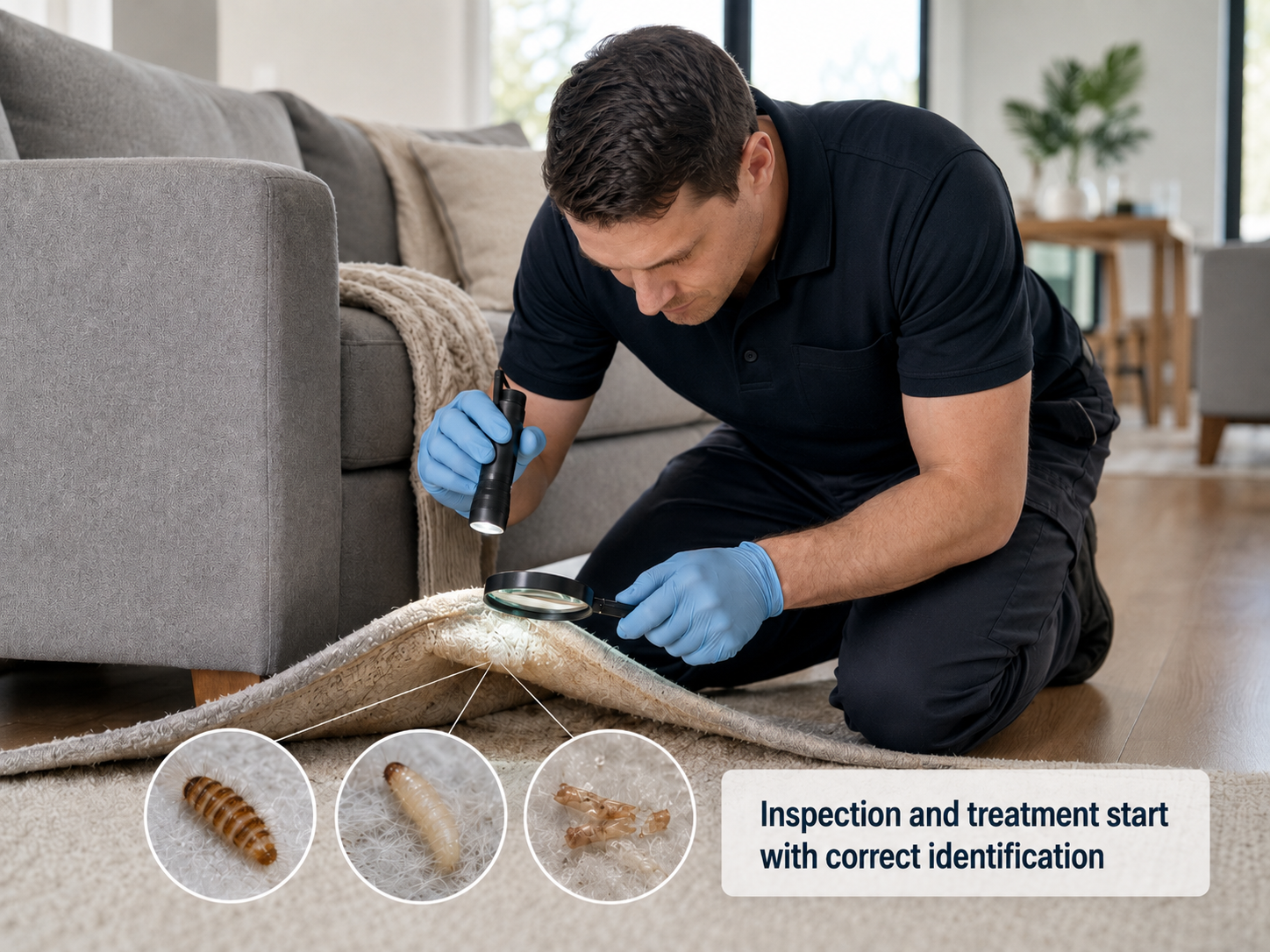
Professional inspection becomes more valuable when damage keeps appearing, larvae are found across multiple rooms, valuable wool carpets or clothing are being damaged, you cannot find the infestation source, previous treatment has failed, or you cannot confidently distinguish carpet beetles from clothes moths.
The first job should be identification.
Then treatment should target the biology and harbourage of the identified pest.
Treating first and identifying later can waste time and allow the real infestation to continue.
Carpet Beetle vs Carpet Moth FAQs
Carpet Beetle or Carpet Moth? The Simple Answer
If you remember only four things from this guide, remember these.
A brown, fuzzy or bristly larva strongly suggests carpet beetle.
A brown, hairy shed skin strongly suggests carpet beetle.
A pale larva with silk webbing strongly suggests clothes moth.
A small portable silk case strongly suggests case-bearing clothes moth.
If all you have is a hole in your carpet or clothing, keep investigating.
The damage tells you something is feeding.
The larvae and the evidence around the damage tell you what.
Correct identification is the most important first step because carpet beetles and clothes moths can damage similar materials while requiring different inspection and monitoring strategies.
If the source cannot be found or the damage continues spreading, arrange a professional pest inspection before more carpet, clothing or other textile material is affected.